


A Daily Chronic Joint Pain Plan: The Missing Steps to Real Relief

A Daily Chronic Joint Pain Plan: The Missing Steps to Real Relief
The Missing Middle in Joint Care
In orthopedic practice, one pattern repeats itself with remarkable consistency. Patients with chronic joint pain are offered medications, injections, or physical therapy early on.
When symptoms progress, surgery eventually becomes the focal point of discussion. Between those two endpoints lies a wide and largely unaddressed gap.
Most patients spend years in this middle ground. This “middle phase” can last for years.
Their pain is not severe enough to justify surgery, yet it is persistent enough to limit movement, sleep, and quality of life. They may cycle through short-term treatments that temporarily reduce symptoms, but they are rarely given a clear, daily framework for how to support their joints over time.
Patients are often told to manage symptoms, stay active if they can, and return when things worsen.
What is rarely provided is a clear, daily framework for how to support joints during this time — a plan that reflects how joints actually function and adapt over months and years.
Why Conventional Care Stops Short of Daily Guidance
Traditional orthopedic care excels at acute intervention. Anti-inflammatory medications reduce pain. Injections quiet inflammation. Surgery restores alignment and structure when degeneration becomes advanced. These tools are valuable and often necessary.
What they do not provide is a longitudinal strategy for maintaining joint health in the years between diagnosis and surgical indication.
This is not due to a lack of knowledge about joint biology. We understand that joints are living systems that respond to load, movement, inflammation, and recovery. Rather, the gap exists because daily joint care does not fit neatly into a single prescription, procedure, or appointment.
As a result, patients are often told what not to do — avoid impact, limit activity, rest when it hurts — without being taught what they should be doing every day to preserve joint function.
From a biological standpoint, this approach is incomplete.
Joint Pain Is a Systems Problem, Not a Single Diagnosis
Chronic joint pain rarely has a single cause.
Even in conditions such as osteoarthritis, pain reflects the interaction of multiple systems: cartilage health, bone remodeling, synovial fluid quality, neuromuscular control, metabolic inflammation, and recovery capacity.
Addressing only one component — for example, inflammation — may provide relief, but it does not stabilize the system as a whole.
Over time, small dysfunctions accumulate. Inflammation becomes chronic rather than adaptive. Movement becomes guarded rather than efficient. Muscles weaken, joint loading patterns change, and recovery slows. Pain persists not because the joint is “broken,” but because the system supporting it is no longer balanced.
This is the reality many patients live with, often without anyone explaining why their symptoms plateau rather than resolve.
This is the phase where most patients feel stuck.
Why a Daily System Is Clinically Necessary
Joints are living tissues. They respond to what happens every day, not just during medical visits.
- Cartilage relies on regular, controlled loading to maintain integrity.
- Synovial fluid quality depends on movement.
- Inflammatory signaling is influenced by sleep, nutrition, stress, and metabolic health.
- Tissue repair occurs primarily during rest and sleep.
When these inputs are inconsistent or absent, degeneration accelerates — even in the absence of dramatic injury.
From a clinical perspective, this makes daily joint support not optional, but foundational. Daily systems are preventive and cumulative by nature. Their benefits unfold over weeks and months, making them harder to measure in short clinical encounters or insurance-driven care models.
The Clinical Rationale for a Daily Joint Health System
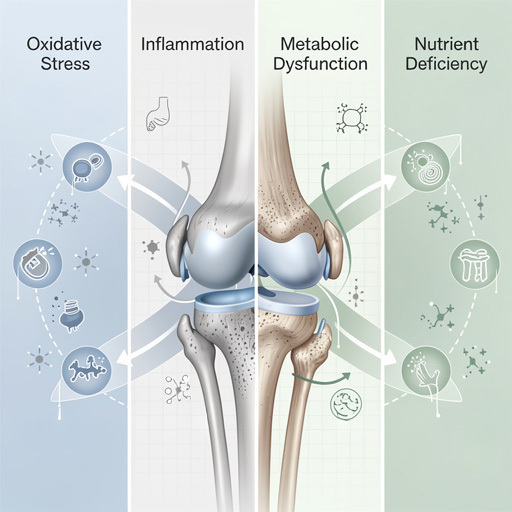
From a biological standpoint, joints require consistent inputs to remain resilient.
Controlled mechanical loading stimulates cartilage health.
Regular movement supports synovial fluid circulation.
Adequate nutrition and sleep allow tissues to recover and adapt. Inflammation must be regulated, not simply suppressed.
When these inputs are absent or inconsistent, degeneration accelerates — even in the absence of dramatic injury.
A daily system is not about aggressive intervention. It is about providing joints with what they need, consistently, to slow breakdown and support function.
Introducing the MEDS Protocol Designed by Dr. Meredith Warner
The reason most patients are never given a daily plan is not because such a plan does not exist. It is because it has rarely been organized into a clear, practical framework.
The MEDS protocol was created to do exactly that.
MEDS stands for Mindset, Exercise, Diet, and Sleep. These are not arbitrary categories.
They represent the core systems that influence inflammation, tissue recovery, pain perception, and mechanical resilience.
This framework did not emerge from theory alone. It developed through years of surgical practice, treating patients who either wanted to avoid surgery or improve outcomes when surgery became necessary.
MEDS is not a substitute for medical care. It is the missing structure that explains how to support the body every day in between.
Why MEDS Is Different From Generic Lifestyle Advice

Get Instant Access to Your Arthritis Relief Guide
In this guide, Dr. Warner outlines her MEDS protocol, suggests recipes and offers up success stories to keep you motivated.
Learn what arthritis really is, uncover its root causes, and discover daily habits that help reduce pain and improve mobility — all in one easy-to-follow guide.
Patients are often told to “eat better,” “exercise more,” or “manage stress.” While well-intentioned, this advice is vague and difficult to apply consistently.
The MEDS protocol differs in two important ways:
- It is systems-based, meaning each component supports the others biologically.
- It is designed to be implemented gradually, without requiring perfection.
It focuses on supporting the systems that influence joint health every day, not just when pain flares.
This includes:
- Regulating chronic inflammation rather than masking it
- Supporting tissue recovery and cellular resilience
- Reinforcing healthy movement and load tolerance
- Addressing the metabolic and nutritional factors that influence pain perception and repair
Importantly, the system is designed to be practical. Patients need clarity, not complexity. They need to understand why each component matters and how it fits into their daily lives.
The goal is not optimization for its own sake. The goal is restoring balance to systems that directly influence joint pain.
The Four Components of MEDS — and How to Start
1. Mindset: Reducing the Physiological Cost of Stress
Pain is not purely mechanical. Chronic stress alters neuroendocrine signaling, increases inflammatory mediators, and amplifies pain perception.
A health-supportive mindset does not mean ignoring pain or “thinking positively” in a superficial way. It means reducing unnecessary stress responses that interfere with healing.
Practical starting points:
- Identify one daily practice that reduces mental load (quiet breathing, meditation, prayer, or time outdoors).
- Reduce exposure to constant negative input, particularly around health catastrophizing.
- Shift focus from “what is wrong” to “what supports recovery today.”
These changes influence cortisol regulation, immune signaling, and pain sensitivity.
2. Exercise: Loading Joints the Right Way
Avoiding movement is one of the fastest ways to accelerate joint decline. The key is not intensity, but appropriateness.
Exercise supports cartilage health, improves synovial fluid circulation, and restores neuromuscular control — all essential for joint stability.
Practical starting points:
- Prioritize resistance training over excessive cardio.
- Focus on controlled, pain-free range of motion.
- Begin with bodyweight or light resistance and progress gradually.
- Consistency matters more than duration.
Exercise should leave joints feeling more supported, not punished.
3. Diet: Reducing Chronic Inflammatory Load
Chronic inflammation is fueled in part by metabolic stress. Highly processed foods, excess sugar, and constant caloric intake interfere with cellular repair mechanisms.
Dietary changes do not need to be extreme to be effective.
Practical starting points:
- Adopt a Mediterranean-style eating pattern emphasizing whole foods, healthy fats, and vegetables.
- Reduce added sugars and ultra-processed foods.
- Pay attention not only to what you eat, but when you eat.
Time-restricted eating — allowing a consistent fasting window overnight — supports metabolic flexibility and tissue repair.
4. Sleep: Where Repair Actually Happens
Sleep is the most underestimated component of joint health. Tissue repair, immune regulation, and nervous system recalibration occur primarily during sleep.
Without adequate sleep, no amount of exercise or nutrition can fully compensate.
Practical starting points:
- Aim for 7–9 hours of consistent sleep per night.
- Establish regular bed and wake times, even on weekends.
- Reduce light exposure in the evening and seek morning light.
- Limit caffeine later in the day.
Better sleep improves pain tolerance, inflammation control, and recovery capacity.
Why the MEDS Components Work Best Together
Each element of MEDS reinforces the others. Better sleep improves exercise tolerance. Exercise enhances sleep quality. Improved diet reduces inflammation and stabilizes energy. A healthier mindset makes consistency possible.
This synergy is what transforms individual habits into a system.
Importantly, no one needs to implement all components perfectly. Even partial adoption improves outcomes.
Where Well Theory Fits In
Well Theory exists to organize and support the MEDS framework in a way that patients can realistically follow.
It provides education, structure, and tools designed around how bodies actually heal — not how healthcare systems are reimbursed.
The goal is not dependency. The goal is understanding.
When patients understand how joint pain develops — and what influences it daily — they are no longer passive recipients of care. They become informed participants.
Rethinking the Path Between Medication and Surgery
Medication and surgery remain important tools. The MEDS protocol does not replace them. It contextualizes them.
When daily joint support is in place:
- Medications are often needed less frequently.
- Recovery from flares improves.
- Surgical outcomes, when surgery is necessary, are often better.
Most importantly, patients regain a sense of direction.
Closing Perspective
The reason so many people feel stuck between medication and surgery is not because nothing can be done. It is because the daily plan has been missing.
The MEDS protocol was created to fill that gap — grounded in orthopedic experience, informed by biology, and designed for real life.
Joint health is not maintained in doctor’s offices. It is maintained in daily practice.
Providing patients with a clear framework does not oversimplify care. It completes it.
Supplements That Support This Routine
-
Antioxidant, Autoimmune, Best Sellers, Brain Health, Energy, Immune System, Mindset, Mood Support, Multivitamins, Oxidative Stress, Shop All, Weight Support
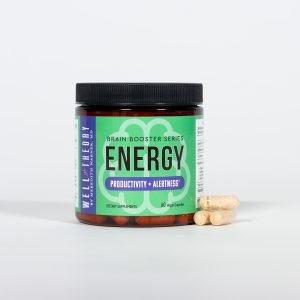
Energy Brain Booster: Lion’s Mane, Cordyceps, L-Tyrosine, ALCAR, & More
$40.00 — or subscribe to save 10% Select options This product has multiple variants. The options may be chosen on the product page



When habits are stacked together, they become automatic.
This removes decision fatigue and makes healthy behaviors feel effortless over time.
Product Spotlight: Inflammation Relief Bundle
If you’re looking to simplify your routine while addressing one of the biggest barriers to consistency, inflammation is a smart place to focus.
The Inflammation Relief Bundle at The Well Theory is designed to support:
Chronic low-grade inflammation
Joint stiffness
Oxidative stress
By bundling complementary products together, it makes habit stacking easier and more effective.
Healing Redefined by Dr. Meredith Warner

Dr. Meredith Warner is the creator of Well Theory and The Healing Sole. She is a board-certified Orthopedic Surgeon and Air Force Veteran.
She is on a mission to disrupt traditional medicine practices and promote betterment physically, spiritually and mentally to many more people. She advocates for wellness and functional health over big pharma so more people can age vibrantly with more function and less pain.
At Well Theory, Our surgeon-designed products are FDA Registered and formulated to help people:
- Manage the symptoms of musculoskeletal pain
- Recover vibrantly from orthopedic related surgeries
- Fill the gaps in our daily diets
- Manage pain associated with inflammation