



Natural Joint Pain Relief: Why PEA is the Missing Link for Stiff Joints
A few months ago, a patient of mine, let’s call her Sarah for privacy, sat in my exam room, looking at her hands with a quiet kind of grief. Sarah is sixty-four, a retired teacher, and a lifelong gardener. But when she spoke, she wasn’t talking about her range of motion or her inflammatory markers.
She said, “Dr. Warner, I missed my grandson’s first steps because I was too stiff to get off the sofa fast enough. I felt like a spectator in my own living room.”
That sentence perfectly captures the emotional cost of chronic pain. It isn’t just about the “aching” or the “throbbing”—it’s about the stolen moments. It’s the fear of the stairs, the hesitation to say “yes” to a walk, and the heartbreak of feeling like your body is a cage.
For Sarah, and for so many of you, the solution has always been “take an ibuprofen and hope for the best.” But hope is not a clinical strategy. To get Sarah back into her garden and onto the floor with her grandkids, we had to stop looking at the symptoms and start looking at the cellular “brake pedal” or things to turn down those pain signals.
Why You’ve Failed Before: The "Generic Supplement" Trap
If you’re reading this, you’ve likely tried the grocery-store aisle approach to joint health. Maybe you bought a bottle of generic Turmeric or a Glucosamine “mega-pack.” And maybe, like Sarah, you felt… nothing.
You didn’t fail the supplement; the supplement failed you.
Most joint supplements fail for three specific reasons:
- Poor Absorption: Raw turmeric powder, for instance, has notoriously low bioavailability. Your body simply flushes it out before it can reach your joints.
- Missing Synergy: Chronic pain is a multi-front war. If you only target one pathway (like enzymes) but ignore the “overactive” nerves and mast cells, you’re only fighting half the battle.
- The Wrong Dose: Many brands “dust” their formulas with expensive ingredients just to put them on the label, but they don’t provide the clinical dosage required to actually change your biology.
The Surgeon’s Deep Dive: PEA and the PPAR-α "Brake Pedal"
In my practice, I don’t just want to “mask” your pain. I want to modulate it. This is where Palmitoylethanolamide (PEA) comes in.
To understand PEA, you have to understand the PPAR-alpha (PPAR-α) receptor. Think of this receptor as a control switch located inside the nucleus of your cells.
When your body is under constant attack from inflammation, that switch gets stuck in the “ON” position. Your cells are essentially screaming in a constant loop of pain signals.
PEA is a fatty acid that your body produces naturally to act as a biological brake pedal.
When PEA binds to the PPAR-α receptor, it “downloads” a command to the cell to stop producing pro-inflammatory cytokines (the “fire” chemicals). But PEA goes further. It also regulates Mast Cells—the first responders of your immune system. When mast cells are overactive, they cause the swelling and “zinging” nerve pain associated with chronic joint issues. PEA calms these cells down, effectively quietening the “noise” of chronic pain at its source. [1]
Furthermore, PEA works through the “Entourage Effect.” It prevents the breakdown of your body’s own natural healing compounds, like Anandamide (often called the “bliss molecule”), allowing your natural recovery pathways to stay active longer. [2]
Visualizing Your Future: The 90-Day Roadmap
Natural healing is biology, not magic. You cannot undo years of inflammation in 24 hours. When I start a patient like Sarah on our Joint Health Multi, I set the expectations early:
- Day 1–30 (The Dulling): You likely won’t feel “cured,” but you may notice the “sharpness” of your pain begins to dull. That first step out of bed feels 10% less like a chore.
- Day 31–60 (The “Yes” Phase): This is where the cellular reset takes hold. You find yourself saying “yes” to an invitation to go to the park without mentally calculating how many benches are along the path.
- Day 61–90 (The Background Music): By now, the inflammatory fire has been significantly tempered. The supplement is no longer something you “wait” to feel; it has become the background music to a life lived in motion.
Who Is This For? (And Who It Isn't)

I believe in medical integrity over marketing.
This is for you if:
- You wake up with “The Morning Creak” (stiffness that takes 30+ minutes to work out).
- You’ve tried generic vitamins and felt no change.
- You want to reduce your reliance on NSAIDs (like Ibuprofen) to protect your gut and kidneys.
- You want to feel better in your body.
This is NOT for you if:
- You expect it to work overnight or even with one bottle. Biological repair takes time.
- Unable to notice small improvements
- Struggle to be consistent with routines
- You have an acute injury (like a fresh bone break) that requires immediate surgical intervention.
The Surgeon’s Recommendation: The Joint Health Multi
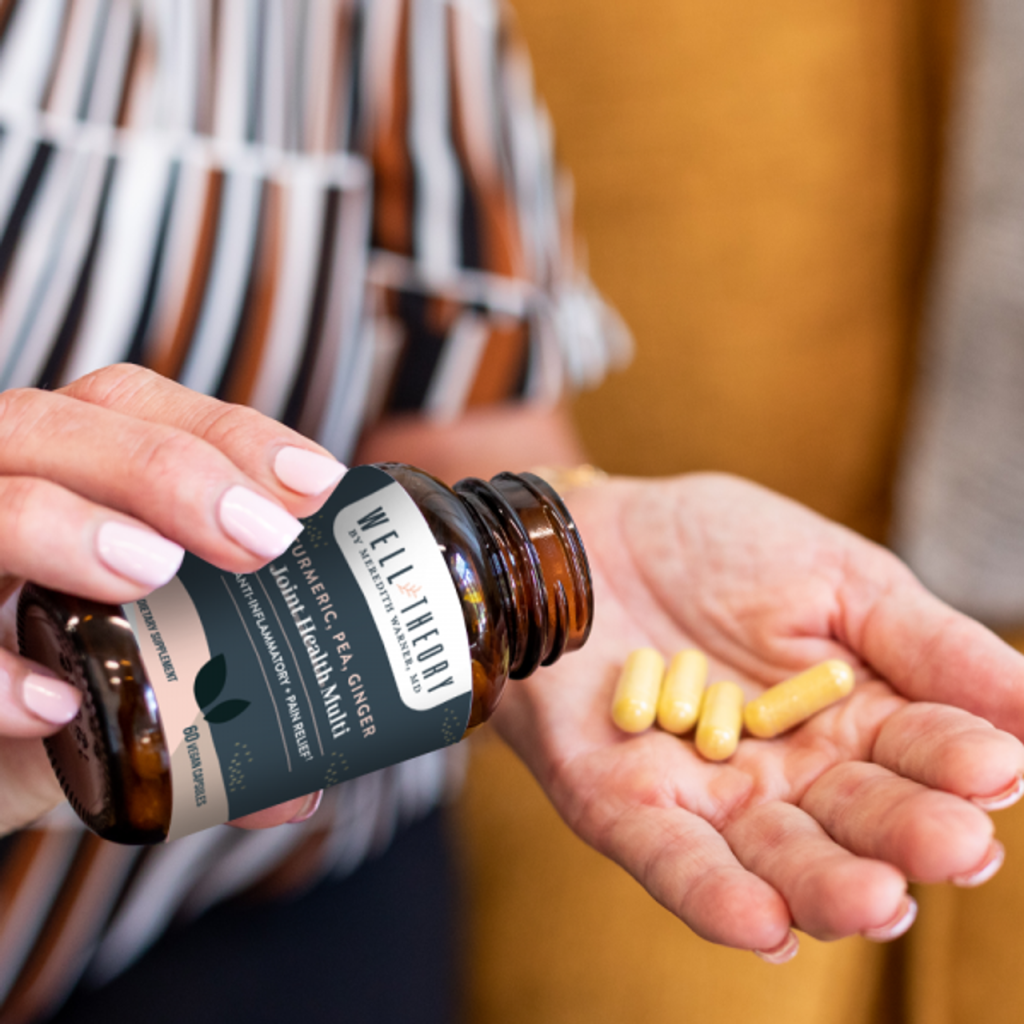
I formulated the Joint Health Multi because I was tired of handing my patients three different bottles. I wanted one “synergistic stack” that addressed the whole joint.
We combined 300mg of PEA (the brake pedal) with 1,000mg of 95% Curcuminoids (the fire extinguisher) and Ginger Root. Most importantly, we added Piperine to ensure these ingredients actually make it into your bloodstream.
I tell my patients: Take this with a healthy fat, like avocado or eggs, stay consistent for 60 days, and keep your body moving.
[Ready to grease the hinges? Shop the Surgeon-Formulated Joint Health Multi here.]
Frequently Asked Questions (FAQ)
- Why haven’t I heard of PEA before?
Because it’s a natural fatty acid, it cannot be “patented” by big pharmaceutical companies. Therefore, there is less “marketing” behind it than there is for synthetic drugs. However, the clinical research on PEA for chronic pain is vast and impressive. [3]
- Can I take this with my current arthritis medication?
PEA is very well-tolerated. However, as an orthopedic surgeon, I always recommend showing the ingredient label to your primary doctor, especially if you are on blood thinners.
- Will this help with my “creaky” knees?
Yes. That “creak” is often the sound of dry, inflamed tissues rubbing against each other. By reducing the inflammatory fluid and calming the pain signals, motion becomes more fluid.
4. Will this help with my nerve based pain?
Yes. PEA (palmitoylethanolamide) helps calm overactive nerves by reducing inflammation around them and signaling the body to turn down pain responses. It works by supporting the endocannabinoid system and mast cells, which are often involved in nerve irritation—helping ease burning, tingling, and shooting pain without numbing or sedating effects.
Evidence & Citations
- [1] Clayton, P., et al. (2021). “Palmitoylethanolamide: A Natural Compound for Health Management.”
- [2] Gabrielsson, L., et al. (2016). “Palmitoylethanolamide for the treatment of pain: pharmacokinetics, safety and efficacy.” British Journal of Clinical Pharmacology.
- [3] Artukoglu, B. B., et al. (2017). “Efficacy of Palmitoylethanolamide for Pain: A Meta-Analysis.”
PEA Supplements That Support Pain Relief
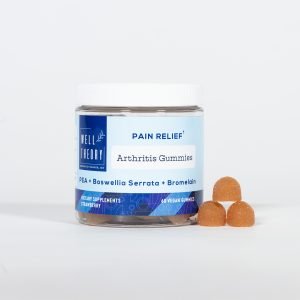
When habits are stacked together, they become automatic.
This removes decision fatigue and makes healthy behaviors feel effortless over time.
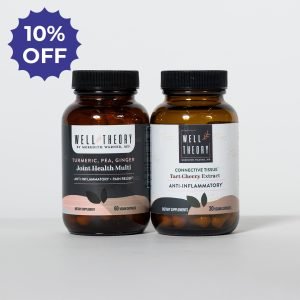
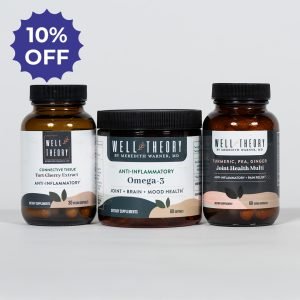
Product Spotlight: Inflammation Relief Bundle
If you’re looking to simplify your routine while addressing one of the biggest barriers to consistency, inflammation is a smart place to focus.
The Inflammation Relief Bundle at The Well Theory is designed to support:
Chronic low-grade inflammation
Joint stiffness
Oxidative stress
By bundling complementary products together, it makes habit stacking easier and more effective.
Medical Disclaimer: This content is for educational purposes and reflects my clinical experience as a surgeon. It is not a substitute for professional medical advice, diagnosis, or treatment.
Healing Redefined by Dr. Meredith Warner

Dr. Meredith Warner is the creator of Well Theory and The Healing Sole. She is a board-certified Orthopedic Surgeon and Air Force Veteran.
She is on a mission to disrupt traditional medicine practices and promote betterment physically, spiritually and mentally to many more people. She advocates for wellness and functional health over big pharma so more people can age vibrantly with more function and less pain.
At Well Theory, Our surgeon-designed products are FDA Registered and formulated to help people:
- Manage the symptoms of musculoskeletal pain
- Recover vibrantly from orthopedic related surgeries
- Fill the gaps in our daily diets
- Manage pain associated with inflammation